· openpilot 0.11.2
Chestnut’s new models, explained
More computing power gives comma four room for a more capable driving model. The latest update also improves how that model learns before it reaches your car.
The key distinction: the 4-billion-parameter world model is used for training. The driving network running with Chestnut is a different model. Keeping those two jobs separate makes the announcement much easier to understand.
A better practice environment. More room to drive.
Think of a driving model as the part of openpilot that turns camera inputs into a driving plan. Chestnut connects a desktop graphics card to comma four, giving that work more computing power than the device has on its own. You still use comma four and your car’s supported controls.
A world model has another job: provide simulated driving experience during development. Our analogy is a practice environment and the driver trained in it. Improving the practice environment can help training; putting a larger driving network in the car gives the trained system more capacity. The simulator itself does not need to travel with you.
- During trainingWorld modelA simulated world helps teach driving.
- After learningTrained driving modelThe learned network is prepared for the car.
- In your carcomma four + ChestnutThe GPU runs the driving network from camera inputs.
For a buyer, the useful question is whether you want the larger-model setup and can accommodate its extra hardware. It remains supervised assistance: the vehicle, software settings, and driver still determine what can be controlled. Compare the two setups.
The technical deep dive
What the parameter counts actually describe
Parameters are learned numerical values. FLOPs count mathematical operations. Neither is a driving-quality score, a download size, or the graphics card’s memory requirement. Here is comma’s October 23 architecture comparison:
0.11.1 small driving model
- Parameters
- 26.595 million
- Computation
- 1.687 GFLOPs
- Vision backbone
- FastViT-T12
0.11.2 big-model table
- Parameters
- 382.905 million
- Computation
- 93.462 GFLOPs
- Vision backbone
- ConvNeXt-XL
The post rounds this to about 15× the parameters and 55× the computation; its vision component alone accounts for 349.283 million parameters. ConvNeXt is a convolutional image-network family. A vision backbone converts images into useful internal features; the policies use those features and temporal context to generate actions.
What a larger world model tells us
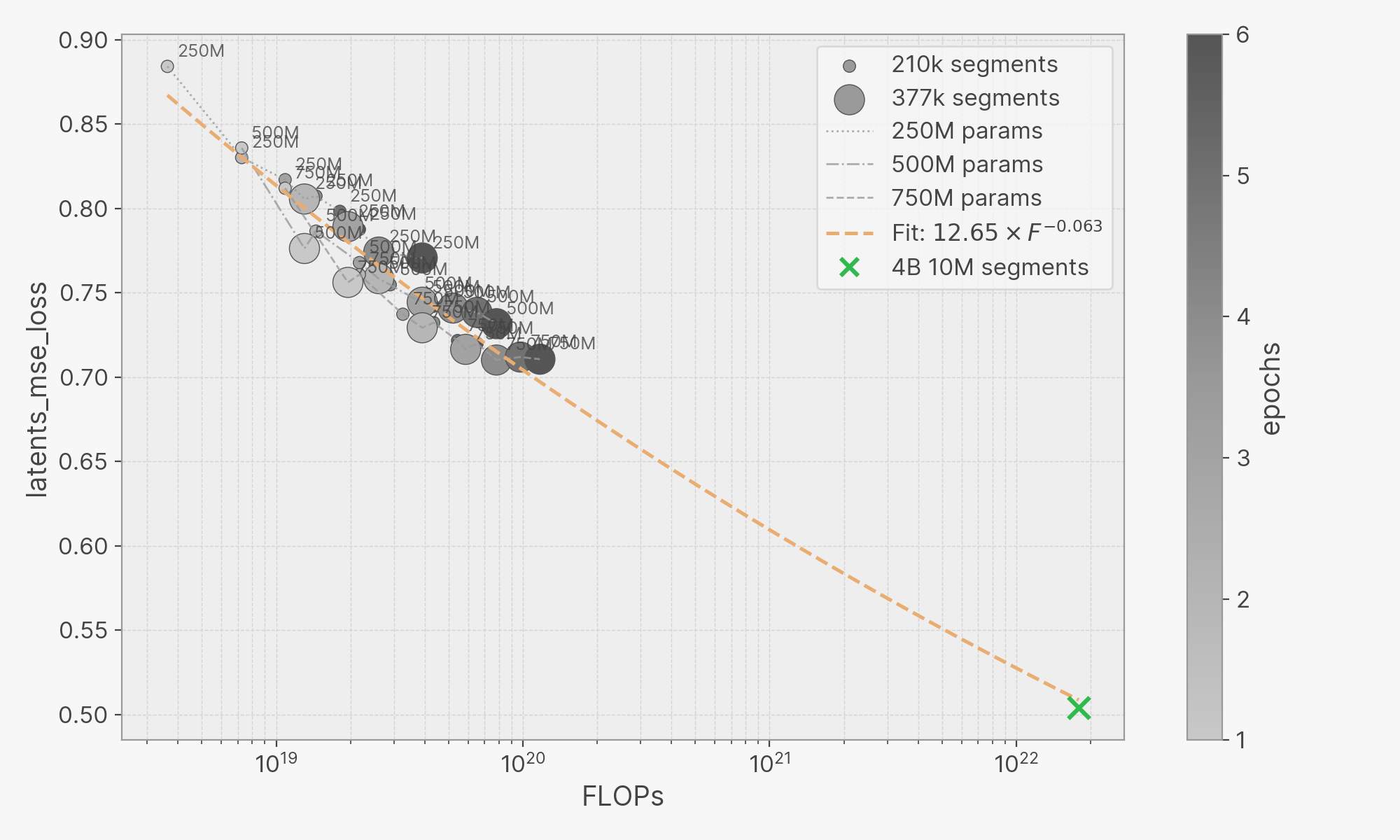
The chart below evaluates the training simulator’s predictions. A lower prediction error can make simulation a more useful development tool. It cannot tell a buyer how often their car will need an intervention. That would require a different evaluation on relevant roads, vehicles, and software.
Learning the consequences of a correction
Reinforcement learning evaluates actions through their later results. Consider a car slightly off-center: a useful correction anticipates where the car will be moments later. Matching a reference action at this instant can miss those later effects. This is our plain-language interpretation of why a longer-horizon learning objective matters.
The release describes a frozen base policy plus a learned residual correction, TD3-based training with five-step returns, and smoothness penalties. The simplified action rule is:
action = base + tanh(correction)
The ResFiT paper explains the residual approach: preserve an existing behavior policy and learn adjustments. TD3 addresses overoptimistic value estimates using paired critics and delayed policy updates. These are training methods; they do not establish that your car retrains itself while driving. See comma’s illustrative lane-centering animation and training description.
What runs on each piece of hardware
The release’s model loader explicitly chooses the big network and an AMD-over-USB backend for Chestnut. The ordinary on-device path selects the smaller network and Qualcomm backend. Driver monitoring has its own local model-loading path.
The image pipeline packs two road-camera frame buffers, uploads them to the target device, then runs image transformation and the driving model. With Chestnut, that places road-image preparation on the external GPU. Moving complete frames is an input-pipeline change; it does not establish that today’s network consumes every camera pixel at native resolution.
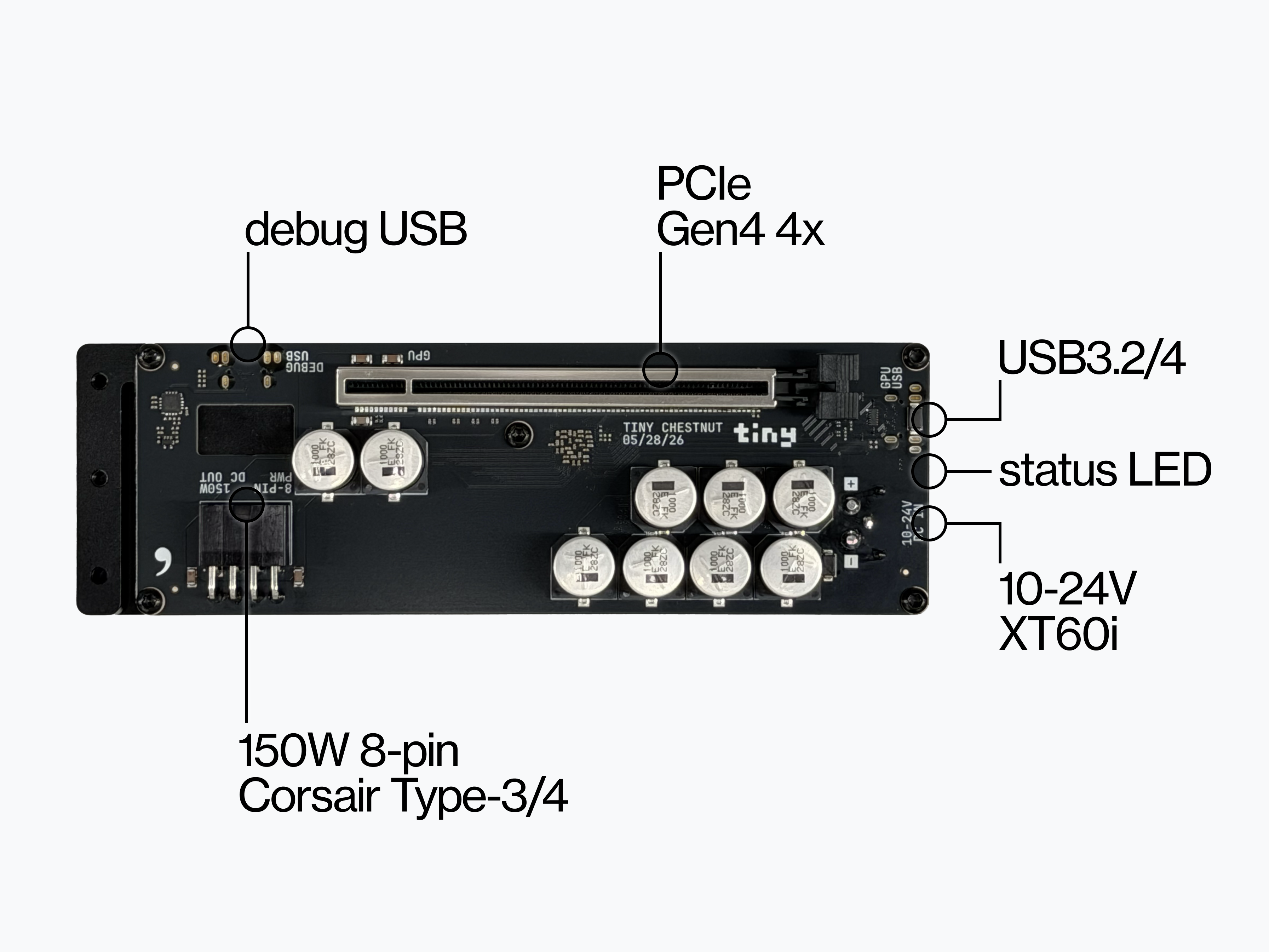
Chestnut is the bridge; the graphics card is separate. comma four uses USB3 through AUX, even though the board also supports USB4. The diagram identifies connectors, rather than specifying how much power any particular vehicle socket can provide.
The shipping USB controller code carries PCI Express requests and memory transfers over USB. Its transfer buffer uses two 256 KiB halves, while the AMD interface maps bridge memory for GPU access. That explains why this setup needs both specialized bridge support and a compatible runtime; a matching connector alone does not establish GPU support.
Startup handling waits up to 60 seconds for the big model. It can request one restart of the on-road cycle to retry, and loads a local model if needed. For a model execution failure, it skips the failed iteration and switches to the preloaded small network. This is fallback logic, not a promise of uninterrupted operation. The regular car-control integration remains in the loop.
Will every smaller model be distilled from Chestnut?
comma’s launch announcement said the autonomy team would focus primarily on Chestnut-class models. That supports a larger-model emphasis. It does not establish that all other model development ends.
Distillation trains a smaller student network using information from a teacher network. It offers a way to transfer learned behavior into a cheaper-to-run model, with results depending on the student’s capacity and training. It is a method, rather than a guarantee of identical performance.
The sources linked here do not confirm that every future on-device model will be distilled, or an 8-billion-parameter model by year-end. The current source still includes local models and separate standard and Chestnut installers. Chestnut’s official in-car target remains comma four; this does not establish support on comma 3X or comma three.
What to do for your setup
Already have Chestnut? Use its supported software channel and follow its status messages. Buying your first comma? Check your exact car before choosing the optional GPU upgrade.