· Models explained
Fairy Tale: openpilot’s big model runs on Chestnut
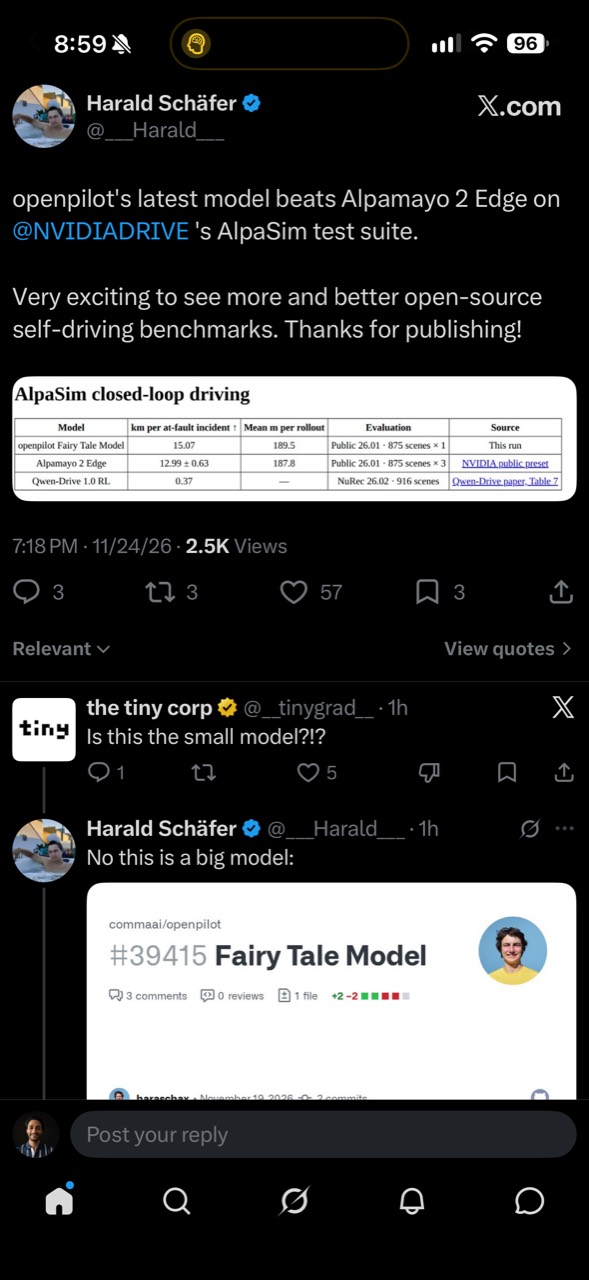
Chestnut gives comma four the power to run openpilot’s big driving models. Fairy Tale shows why that extra compute is exciting: a reported simulation result puts it ahead of NVIDIA’s public Alpamayo 2 Edge preset.
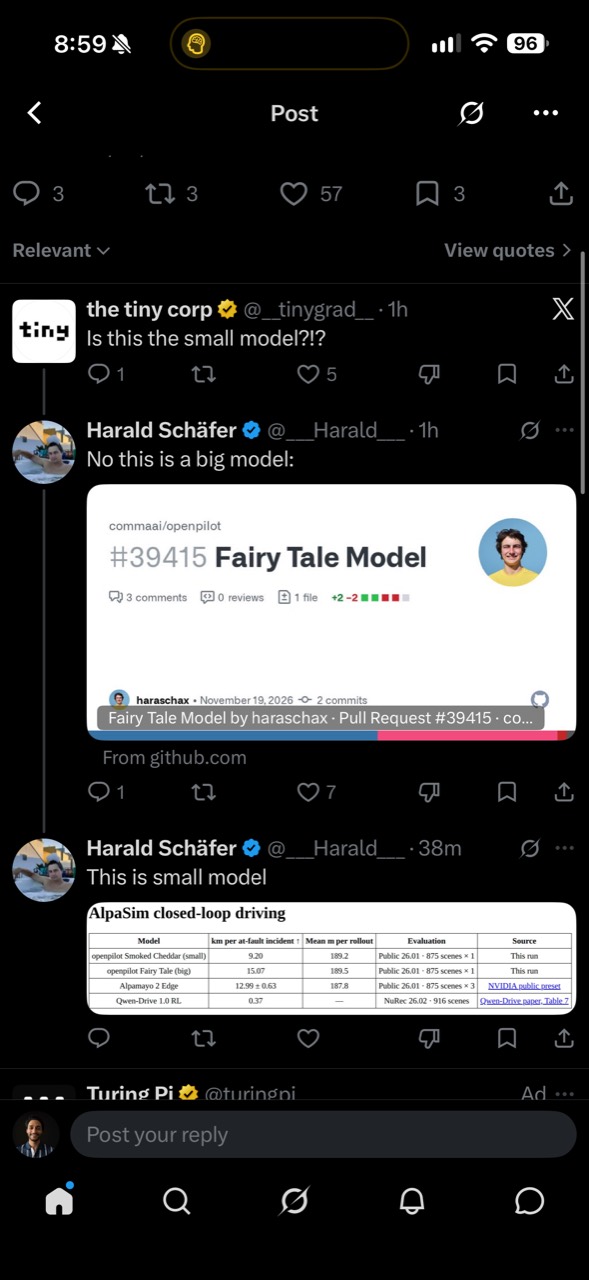
The model in that result is the big model. In the November 24 post shared by Harald Schäfer, the smaller Smoked Cheddar model appears separately. That distinction matters when you are deciding what Chestnut adds to your setup.
Big models run on Chestnut
A driving model turns camera input and driving context into a plan. Running a larger network takes more computing power. Chestnut connects a desktop GPU to comma four, giving openpilot room to run a much larger driving network than the on-device path. The ready-to-drive kit includes an AMD Radeon RX 9060 with 8GB of memory, power and USB cables, and mounting strips.
- Inputcomma fourCamera input and driving context
- ComputeChestnut + GPUThe big driving model runs here
- OutputA driving planUsed within your car’s supported controls
This is the driving network doing inference in the car. A world model used for training has a different job; our model and training explainer walks through that distinction.
What Fairy Tale changes
comma merged Fairy Tale Model, pull request #39415, into openpilot’s development branch on November 22. The change replaces the big driving-model artifact. It does not replace the small driving-model artifact. The accompanying replay report also explicitly identifies the big-model path as Chestnut.
That gives the result a concrete hardware connection: Fairy Tale belongs to the external-GPU model path. A merge into development does not establish that your installed stable build contains it. Check your software’s model and release information before assuming you are driving the same model.
Source: the exact model change and openpilot’s Chestnut model loader at the merged revision.
The AlpaSim result, with the conditions attached
AlpaSim is NVIDIA’s open-source simulator for testing driving policies in a closed loop: the model’s decisions affect what happens next. This tests how a policy behaves as a simulated drive unfolds.
Schäfer’s shared table reports the following results on the Public 26.01 evaluation. The main metric is kilometers per at-fault incident; higher means more simulated distance between incidents assigned to the driving policy.
openpilot Fairy Tale
Big model · Chestnut- km per at-fault incident
- 15.07
- Mean meters per rollout
- 189.5
- Evaluation
- 875 scenes × 1 rollout
NVIDIA Alpamayo 2 Edge
Public AlpaSim preset- km per at-fault incident
- 12.99 ± 0.63
- Mean meters per rollout
- 187.8
- Evaluation
- 875 scenes × 3 rollouts
openpilot Smoked Cheddar
Small model- km per at-fault incident
- 9.20
- Mean meters per rollout
- 189.2
- Evaluation
- 875 scenes × 1 rollout
Source: Harald Schäfer’s November 24 post, reproduced from the supplied screenshots. The two openpilot rows report one rollout per scene, without uncertainty ranges. CommaGuide has not independently rerun them.
Fairy Tale has the highest displayed score in this comparison. It also scores above the small Smoked Cheddar model. That makes it an encouraging result for the big-model approach, while leaving an important question open: how consistently does the advantage hold across repeated runs and other driving situations?
The table’s Qwen-Drive row uses NuRec 26.02 with 916 scenes, so we have left it out of this comparison. Different evaluation sets should not be read as one leaderboard.
What this means for your comma setup
Chestnut is the upgrade for running bigger driving models. If you want that development path, the practical starting point is comma four, Chestnut, and a software build that includes the intended big model. Hardware alone does not choose Fairy Tale or prove that a particular build ships it.
For a regular comma four setup, Chestnut remains optional. The small-model result is a separate result, and this benchmark does not measure every on-device model or every community fork. It also does not establish official Chestnut support for older devices.
For driving, treat this as progress in model development. A simulation score cannot tell you how often you will need to take over on your commute. Your exact car’s steering and gas/brake support still applies, and you remain responsible for watching the road and taking control when needed.
Sources and further reading
- comma: Fairy Tale Model #39415 — merge, model change and replay context.
- openpilot model runtime — big-model loading at the Fairy Tale revision.
- comma: Chestnut product page — hardware and official comma four pairing.
- comma: Introducing Chestnut — why the external-GPU model path exists.
- NVIDIA: AlpaSim — closed-loop simulator.
- NVIDIA: Alpamayo 2 Edge evaluation notes — public preset, model-card comparison and variability.
View the source post screenshots
Credit: Harald Schäfer on X; screenshots supplied to CommaGuide. The original post URL was not available during verification. These preserve the reported numbers and the big/small clarification; they are not a reproducible benchmark run packet.
Primary code and documentation checked November 25, 2026. Recheck due December 2, 2026.